


Response in response toInspection Service of Value
Following the episodeInspection Service of ValueI would like to respond about wax strips. Although we were not approached by the editors, I did feel the responsibility to explain our story, because Cosmeau also sells wax strips and our packaging was shown.
Why was our packaging on display?
Keuringsdienst van Waarde has an old batch of our packaging, because we purchase for months and changes become visible much later.
Important to emphasize: on our product page we havenever without explanationclaims that this is a completely plastic-free detergent.The product pages were updated around the summer. Because PVA degradability is a gray area, we are correctmultiple perspectives shared, including that ofECHA (the European Chemicals Agency)and thePlastic Soup Foundation, so that customers could make an informed choice themselves. We have this productnot sold as 'plastic-free' to Keuringsdienst van Waarde.
It's a shame that they have old packaging,We were not contacted to request additional information or context.
Transparency about PVA
We have been open about the use of PVA and the associated uncertainties for a long time. OnOctober 2we have an extensive article about thismail shared on our socials, in which we also indicated that we have been working on an alternative for months. This message has also been shared via our newsletter to customers.
Why are so many people shocked and angry?
Despite this transparency, we receive many angry and sad reactions. I completely understand that.
My guess is that this is because wax strips have been positioned asplastic-free. That message stuck:wax strips = plastic-free.
We have been deliberately advertising here since the beginning of this yearno moreas soon as it became clear that this cannot be stated in black and white. We shared this via mailings and social media, but not everyone actively follows us there. For customers who have been buying from us for some time and have not followed this topic anymore (which is very understandable), this may come as a shock.
I honestly don't know how we could have communicated this even better. If you have any ideas about that, I'd love to hear them.
Then the second point: what exactly is PVA?
Based on studies and tests* from raw material suppliers, suppliers, and international studies, we have always assumed thatcompletely organicwould break off. We did not take Dutch water treatment plants into account here.
We do know that the degradability of PVA varies per brand and type. We use the Japanese premium brand Kuraray and they have submitted tests showing that their PVA is biodegradable.
It still is, only under certain circumstances that do not always apply in Dutch water treatment plants. This depends on the bacteria present, which can differ per installation and region.
When this became clear and therefore not the sustainable endpoint we hoped for, we have took immediate action. Not only in communication, but also in terms of content.
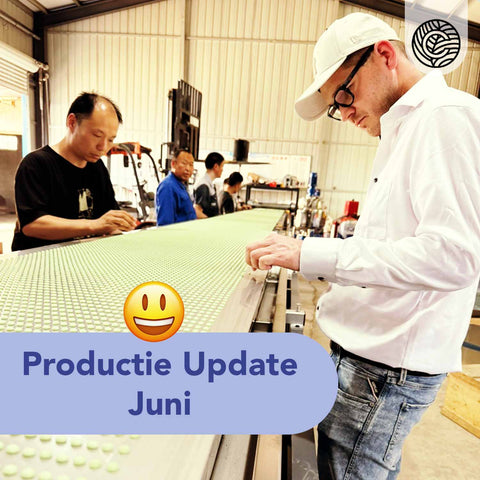
We accelerated our planning and decided ourown detergent production a year earlierto be realised. As is known, we already produce our scented pearls in the Netherlands (without PVA and microplastics), and one is currently being built next to our officenew production hall of 2,500 m²built.
Our goal is a next generation detergent that meets all these requirements:
-
· (micro)plastic-free
-
· biodegradable
-
· easy to dose
-
· preferably not liquid
-
· no (recycled) plastic bottle
-
· not as heavy as powder
-
· high washing power
-
· strong odor
-
· scalable with limited resources
-
· ingredients largely from the EU
-
· no fabric softener needed (optional)
Such a product does not yet exist, but we are making clear progress. We will continue to communicate transparently about this in the near future.
About the statements inInspection Service of Value
The episode comes full circle14:38scientist Heather Leslie interviewed. She states that PVA only breaks down under very specific conditions, with trained micro-organisms and at 60 °C. Discussions then take place with a water treatment plant, which gives the impression that PVA does nothing there.
We do not want to question Keuringsdienst van Waarde, but this performance isincomplete**and we are happy to add to it.
Dutch water treatment plants are very modern. PVA also exists in different degrees (degree of hydrolysis and molecular weight), and no distinction was made in the broadcast. The 60 degree test is onelaboratory standard, but not the only way PVA can be broken down**. In the test report* carried out by TüV, degradability was determined at 90% over 28 days and tested at 22 degrees with a 2 degree variation.
In addition, playssludgean important role. Part of the PVA binds to sludge, which becomes sludge in the Netherlandsburned or fermented***. This means that this part is actually removed from the system.
Another partcan,depending on the installation, are partially broken down by bacteria and enzymes. This varies per water treatment plant and is something I am currently investigating further. I will come back to this later.
It's true that water treatment plantsare not designed to specifically break down PVA. They are designed to remove general organic loads, nitrogen and phosphate. PVA degradation is thereforesecondary and incidental, but that doesn't mean nothing happens.
Bacteria can also produce substancesco-metabolize, change them enzymatically or partially break them down, without using them as a staple food.
About the “plastic” in the lab
The image of PVA being heated and forming a plastic-like residue is reflectivenot how PVA ends up in the environment. It gives the impression that there isa piece of plastic is discharged with every wash, and that is not correct.
Now that we know all this, what will be left behind?
Our wax strip weighs approx1.71 grams, of which15–35% PVA. In the extreme case this amounts to approx0.6 grams of PVA. Some of this is destroyed via sludge and possibly some is biodegraded.
For comparison: this is in the same order of magnitude as the amount of microplastics released when washing one polyester shirt. The important difference is thatpolyester microplastics are solid fibers that persist and accumulate, while PVA is soluble and less persistent. That doesn't make PVA ideal, but it doesless harmful than classic microplastics.
Your fitness outfit or the kids' football shirts pose a bigger problem if you put this into perspective.
In summary
We thought too easily, because ECHA does not see it as microplastic and it was biodegradable, that we could carry this within our requirements as a brand.Microplastic-free is not the same as plastic-freeand we always saw microplastic-free as a higher standard.
Harsh chemicals in traditional detergents often have a greater impact on aquatic life than PVA. If you look at microplastics, what is left behind is less harmful and also less than a football shirt or your leggings. PVA is non-toxic, is partly broken down and partly destroyed through sludge processing. It is not a perfect solution, but also cannot be compared to dumping solid plastic into the environment.
That doesn't change the fact that we are PVAwant to replaceand we are working hard on that, not in response to this episode, but six months ago since we learned more about this. We then communicated this within all our channels, adjusted our advertising communications, adjusted our packaging and decided to produce detergents ourselves in our new factory hall (completion mid-March 2026) next to our head office in Velsen-Noord.
The expectation is that the first version will be inQ1 2026is available.
Thanks for reading.
Jason
Explanation (as stated on the product page since summer 2025)
Depending on the definition, the wax strips may or may not be microplastic-free. PVA has been approved by ECHA and is not classified as microplastic there, but it is by the Plastic Soup Foundation. There are studies showing that PVA can be biodegradable depending on type and application. We have a certification according toOECD 301B. Our packaging is completely plastic-free and FSC certified. We are also conducting research into cellulose-based carriers to avoid this gray area.
***How does a sewage treatment plant work - Vallei Veluwe
www.brabantsedelta.nl/rioolwater purification
waternet.nl/ons-water/rioolwater/water purification/
www.vechtstromen.nl/werk/puuren-trouwwater/werking/
**The water solubility of PVOH depends mainly on its degree of hydrolysis (DH), and to a second extent on its degree of polymerization (DP) (Finch [10]). This is determined by two counteracting influences of the hydroxyl groups. On the one hand, the many hydroxyl groups cause PVOH to have a high affinity to water, which drives water solubility. On the other hand, the strong hydrogen bonding between inter- and intramolecular hydroxyl groups can greatly impede solubility in water. As a consequence, fully hydrolysed PVOH is highly crystalline and only dissolves in hot water (> 60°C), whereas 'partially hydrolysed' PVOH is more weakly hydrogen-bonded, less crystalline, and generally soluble in cold water (< 10 °C) (Monosol [16]). Finch [10] shows high water solubility at ambient temperature (20 °C) for PVOH with a degree of hydrolysis up to 90%, but rapidly dropping with further increasing DH. The observed negative effect of an increasing degree of polymerization (in the range of 500– 2500) on solubility was of limited relevance for PVOH with a degree of hydrolysis < 90%. This is illustrated in Figure 2 for a degree of polymerization of 1750 (after Finch [10]). Note that for practical detergent applications, PVOH films are modified and contain additives, to ensure that they are 100% soluble in cold water (as opposed to what is shown in Figure 2 for pure unmodified
Source
www.mdpi.com/2073-4360/13/21/3742
*Degradable labor test reports:
Raw material supplier:
https://cosmeau.s3.eu-west-3.amazonaws.com/test_report_kuraray.pdf
Manufacturer TüV test:
https://cosmeau.s3.eu-west-3.amazonaws.com/test_report_tuv2.pdf
OECD-B301 always tests under 28 days of degradability. Material can continue to degrade, but this is no longer included in the standard test.


 Prices that are accessible for









3 comments
Ik ben heel erg blij met deze uitleg, want inderdaad geschrokken van de berichten in ‘keuringsdienst van waarde’. Plaatst alles voor mij weer in perspectief en ik ben blij dat jullie het serieus nemen en blijven zoeken naar het beste resutaat. Wasstrips zijn overigens prima om mee te wassen, alles wordt schoon.
Bedankt voor jullie uitgebreide reactie.
Jullie wasstrips hadden mij al bij de vervanging van de grote plastic containers, ruimte besparing en geurtjes. Alles wat jullie product nog milieuvriendelijker maakt is voor mij een WIN.
Succes met de onderzoeken en ontwikkelingen!
Beste Jason, dank voor je uitleg.
Ik kijk graag naar het programma Keuringsdienst van Waarde, ze onderzoeken en communiceren wat ze hebben gevonden, eerlijke onderzoeksjournalistiek. Na hun uitzending kijk ik altijd weer eens met een andere bril naar zaken die je jezelf wel eens afvraagt. Door hun programma blijven we met elkaar communiceren, het houdt ons scherp en blijven we verbeteren.
Je zult nooit alle mensen kunnen bereiken via sociale media, maar blijf in gesprek en laat ook van je horen als er kritiek geleverd wordt. Dat is de beste reclame ;)
Ik kijk uit naar jullie plastic vrij product, tot die tijd blijf ik jullie Wasstrips en geurparels gebruiken